
Written by: Keyola Greene
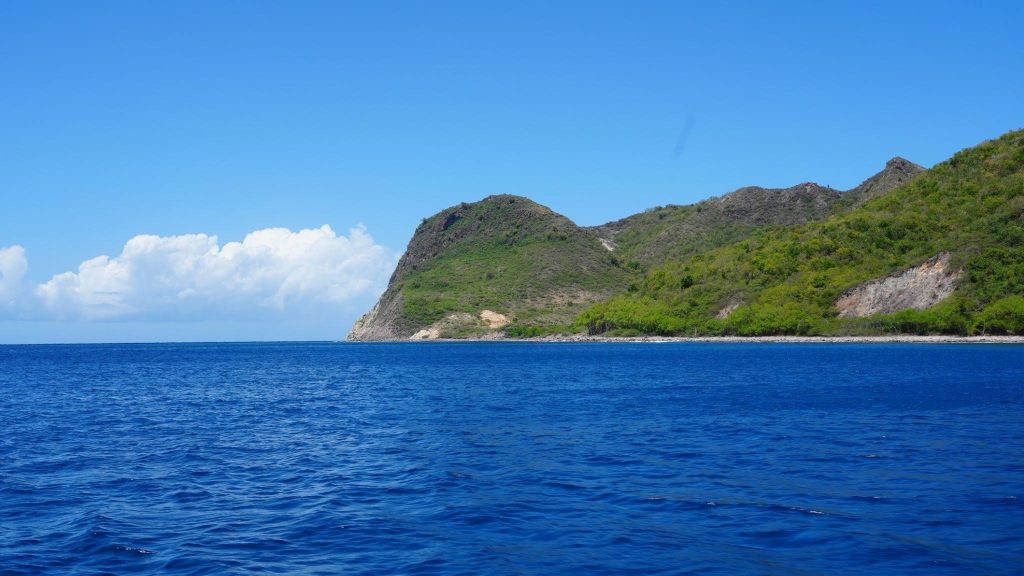
Montserrat depends heavily on the ocean. It has supported the economy, boosted tourism, facilitated transportation, and sustained livelihoods, but when decisions about the future of the deep seabed are negotiated internationally, who actually speaks for Montserratians? This question reaches far beyond our black-sand shores and opens up a wider conversation about representation, influence, and the future of the Caribbean Sea.
Increased interest in the emerging deep-sea mining industry has sparked concern about how the region is represented in international ocean governance and who has a seat at the table. For decades, Caribbean islands have collaborated to address issues that transcend their individual borders. But what does that cooperation look like when the seas connecting the region do not recognize political boundaries, and everyone does not possess the same or equal power to influence change?
For overseas territories like Montserrat, it is more complicated than regional collaboration. It is about individual representation, access to the decision making process, and being able to influence the course of action that will directly affect us.
Deep-Sea Mining
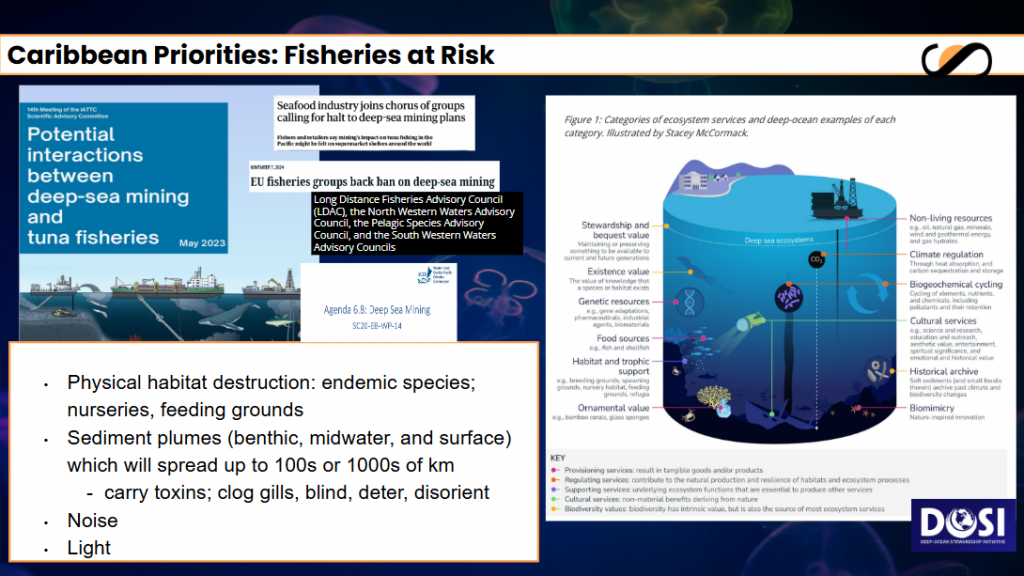
The deep sea, which is generally classified at a depth where light begins to fade (typically around 200 meters), has been described in a 2007 UN Environment Programme report as “the oldest and largest biome on Earth” that “we have little knowledge of”. It is home to diverse and largely unexplored ecosystems, with unique species and habitats that have adapted to extreme conditions such as darkness, high pressure, and low temperatures. On the seafloor in some parts of the deep ocean are polymetallic nodules, which contain valuable mineral deposits such as cobalt, nickel, manganese, copper, silver, zinc, and other rare metals. These nodules are among the primary targets of deep-sea mining
Proponents argue deep-sea mining could provide additional sources of minerals needed for various technologies, while critics question whether the environmental risks are justified given the scientific uncertainties.
Much of the exploration and commercial attention has primarily been focused within the Pacific Ocean, particularly the Clarion-Clipperton Zone between Hawaii and Mexico, with small projects taking place in parts of the Atlantic, Indian, and Western Pacific oceans. However, discussions are ongoing over how exploitation should be governed, and while the Caribbean is not currently under the spotlight, some Caribbean states are part of the conversations.
Why DSM Matters for the Caribbean
The Caribbean’s interest in deep-sea mining should be heightened by the fact that decisions made about commercial seabed mining in one area could set precedents for how the wider ocean is governed.
When assessing the Caribbean’s role in deep-sea mining, the region must look to accountability, preparedness, and influence.
Senior Campaigner at RISE UP for the Ocean, Khadija Stewart, says governments considering their involvement must weigh the potential economic benefits against public resources, risks, and limited capacity.
“If governments are investing significant public resources in preparing for or participating in deep-sea mining, they should be able to demonstrate why that investment is in the national interest,” she said.
Stewart said, “Building the institutions needed to regulate a new extractive industry has to be weighed against the many other urgent ocean, climate and development priorities facing the region.”
“Governments are operating with limited scientific, technical and financial capacity while trying to respond to multiple crises at once. Adding another poorly understood layer of risk without knowing the scale, duration or cumulative consequences would make an already difficult governance landscape even more challenging,” she said.
Concerns of deep-sea mining should not solely be based on what happens at a mining site.
Independent Ocean Conservation Policy Consultant Bobbi-Jo DoBush warns that “plumes from deep-sea mining could travel hundreds or thousands of kilometers and affect the entire midwater food web, up to commercially important fish.”
“Noise from deep-sea mining would affect many animals, including those that use sonar for communication, including whales, which provide significant tourism revenue,’ she said.
Stewart says this creates a serious preparedness challenge.
“We cannot adequately plan for impacts that science still does not fully understand. Significant gaps remain around deep-sea biodiversity, ecological connectivity, ecosystem functions, recovery and the potential wider consequences of industrial-scale disturbance,” she said.
What does meaningful representation look like?
The international seabed is governed by the United Nations Convention on the Law of the Sea (UNCLOS), with the Jamaica-based International Seabed Authority (ISA), the international organisation responsible for organising and controlling mineral-related activities in the Area. Caribbean States that are parties to UNCLOS are automatically members of the International Seabed Authority and participate in its Assembly, the Authority’s plenary decision-making body. These include Antigua and Barbuda, The Bahamas, Barbados, Belize, Cuba, Dominica, the Dominican Republic, Grenada, Guyana, Haiti, Jamaica, Saint Kitts and Nevis, Saint Lucia, Saint Vincent and the Grenadines, Suriname, and Trinidad and Tobago.
Participation in the ISA Council is more limited: in 2026, Jamaica and Trinidad and Tobago are the Caribbean states serving on the 36-member Council, where much of the detailed negotiation on the regulatory framework for deep-seabed mining takes place. Caribbean Overseas Territories have different constitutional arrangements and do not participate in the ISA in the same way as independent states. For British Overseas Territories, for example, the UK is responsible for external relations, while the territories retain significant self-government.
For British Overseas Territories (BOTs) like Montserrat, the question of who has authority over deep-sea mining has been an ongoing discussion in the United Kingdom (UK) Parliament. On 24 May 2021, the late Lord Jones of Cheltenham asked the Government whether it had the power to issue deep-sea mining licenses in the waters of BOTs and whether it planned to do so.
In his response, then Minister of Government Lord Callanan said “the Deep Sea Mining Act 1981 (as amended by the Deep Sea Mining Act 2014) sets out the Government’s powers in relation to issuing deep sea mining licences, including the relationship with contracts granted by the International Seabed Authority (ISA).”
At the time, he said, “no such Order in Council or Statutory Instrument has been taken forward, and there are no current plans to do so.”
Environmental groups including Greenpeace have criticised what they describe as a contradiction between the UK’s support for a moratorium on exploitation and its continued sponsorship of exploration contracts. While the UK has publicly supported a moratorium on deep-sea mining exploitation, it continues to sponsor two exploration contracts in the Clarion-Clipperton Zone.
In a press release issued in 2025 by Greenpeace UK, an independent global campaigning network that works to protect and conserve the environment, Chris Thorne, Senior Oceans Campaigner said “Sponsoring a deep-sea mining company is not the same as supporting independent ocean science. As a growing list of countries, companies and scientists turn their backs on the deep sea mining industry, the UK should stop propping it up and start using its influence to grow support for a global moratorium. Anything less undermines its claims to be serious about ocean protection.”
This criticism leaves room to question how the UK balances its own policy position with responsibilities for the OTs. In the ‘2010 to 2015 government policy: UK Overseas Territories’ published by the Foreign, Commonwealth & Development Office, the UK Government said in matters where it represents its OTs “we will make every effort to ensure that the Territories are consulted and their interests defended”.
However, this does not guarantee being heard.
Stewart says representation “does not automatically mean the ecological, economic, cultural and community realities of an island are shaping the position being taken internationally.” She says meaningful representation goes beyond simply being invited into the room.
It means being involved early enough to shape the position, having a place in delegations, access to resources and technical support to participate effectively, and the ability to take those conversations back to the communities whose futures are being negotiated.
Stewart believes there is value in stronger coordination among Caribbean Overseas Territories and non-sovereign jurisdictions themselves.
“If they are able to identify common ocean priorities and exchange positions ahead of major negotiations, they can bring more collective weight to international discussions rather than appearing only as individual territorial concerns,” she said.
Montserrat’s Place in the Conversation
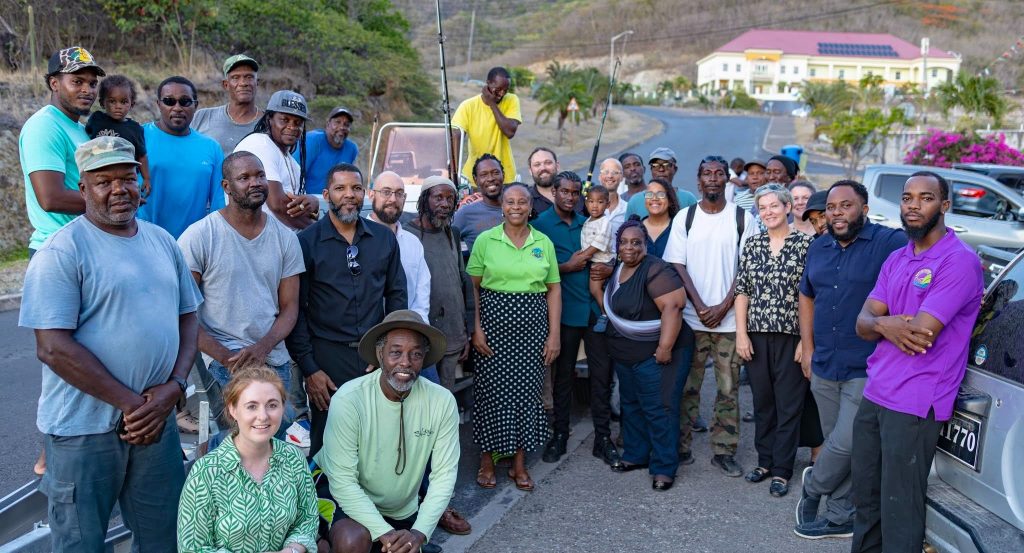
Source: Ministry of Agriculture, Lands, Housing & the Environment
Deep-sea mining is not yet a widely discussed topic in Montserrat, be it among the public, fisherfolk, or at the government level. While there is not much familiarity with the industry itself, there is an understanding of what it could mean for the island and the potential impacts it could have on marine ecosystems and fishing patterns.
Local fisherman Shane Caesar, who says the ocean is central to his livelihood, has expressed concern that fishfolk are not sufficiently involved in decisions and discussions related to the marine environment.
He said while they may be invited to meetings and asked for their opinions, it is unclear whether they actually influence decisions or whether projects have already been planned before consultation takes place.
According to him, local fishing patterns have already shifted, with traditional fishing grounds becoming less productive, fish stocks appearing to decline, and fish becoming smaller and less abundant.
While Caesar comments have put a face to the technicalities of the discussion, Marine Biologist and Director of Fisheries within the Ministry of Agriculture et al., Daniel Edwards, has emphasized Montserrat can not afford to ignore the possible implications of deep-sea mining, if given the green light.
He said, “In Montserrat, we depend heavily on the sea, and even a low-probability impact matters a lot to a small island with limited alternative resources than it does to many other societies”.
According to Edwards, the interconnectedness of marine ecosystems in supporting fisheries makes the health of the entire ocean of particular importance for small islands.
He said Montserrat still has the responsibility to advocate for its interests, be vocal, and have a legitimate expectation that the island will be consulted by the UK before they’re making decisions on our behalf that affect the future of the whole ocean.
Marine Conservationist Veta Wade, believed the challenge for Montserrat and other OTS lies with capacity and true representation
She said, “true participation would mean resourcing our local science, valuing our experiential expertise, and creating spaces where Montserratians can speak for themselves in deep‑sea governance debates”.
The Marine Conservationist believes that to ensure Montserrat’s voice is heard, the island can strengthen locally led research on its deep-sea environments and build alliances that will forge partnerships with regional media and corporate entities focused on blue economy policy.
Local Knowledge Building Efforts
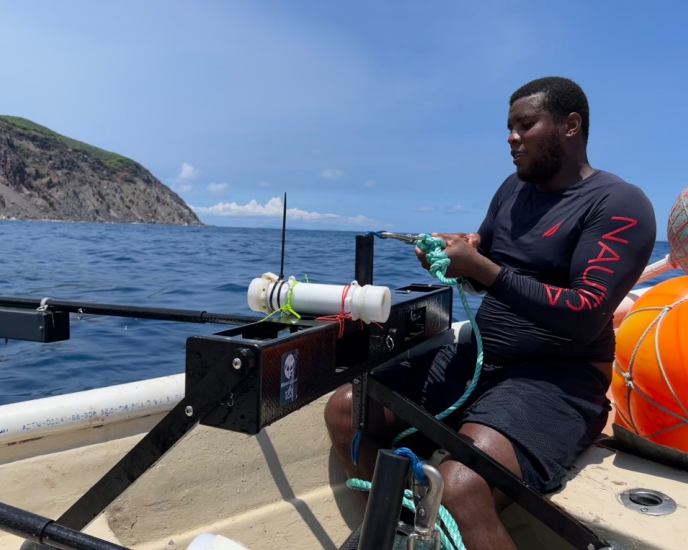
Remote Underwater Video Station
Photo credit: Veta Wade.
Despite shortfalls in resources and local expertise, work is being done to strengthen knowledge and capacity in the local marine sector, with the aim of better understanding and being positioned to manage the island’s waters. It is known that 98.3% of the island’s Exclusive Economic Zone (EEZ) is deep sea of 200 m and beyond, yet there is still limited information about the biodiversity and resources found there.
Wade, who is also the Founder of Fish N’ Fin’s Montserrat, is among those working to address these gaps. Through her Project Deepwater, Wade is looking to explore and document Montserrat’s deep-sea in search of evidence-based data on the island’s marine megafauna population.
The project uses a low cost deep-sea camera and sensor system known as Maka Niu, co-designed by Montserratian fishers, that is used for monitoring a variety of Montserrat’s coastal environments such as inshore reefs, seagrass beds, and rocky shorelines.
Outside of her Deep Water Pilot work, Wade says Montserrat is only beginning to establish baseline information about its deepwater environment, which is essential to making informed decisions.
The Government of Montserrat is contributing to the knowledge building and management efforts through the UK Government’s Blue Belt Programme.
In January 2026, the island hosted a two day Blue Belt Scoping workshop which focused on objectives, benefits and next steps for collaboration on the protection and sustainable management of the local marine environment.
By June, Montserrat had formally joined the programme, allowing for access to scientific expertise and resources to support marine protection and ecosystem resilience. The programme will support underwater habitat surveys, science-based fisheries management, a review of marine legislation, and the development of local capacity and expertise.
Officials at the Blue Belt Programme Action Planning Workshop Opening Ceremony say these efforts will help bolster the scientific foundation Montserrat needs to determine its interests and priorities in the marine environment.
However, Fisheries Director Edwards said Montserrat must continue developing its own position, based on scientific understanding and regulation, while working through the United Kingdom to ensure its interests are effectively represented.
Is the Caribbean Even Being Heard?
The challenge of representation faced by the OTs is not unique but is unfolding across many small island developing states under the banner of whether they have the capacity and influence to make their seat at the table count.
Stewart said meaningful Caribbean representation must go beyond having a seat at the table. She said it involves having representatives who understand the issue, understand the negotiating process, and are equipped to contribute substantively to the discussion.
While stressing the importance of having diverse delegations, she said Caribbean countries must be consistent participants, engaging not only at major international meetings but throughout the negotiation process.
And while the discussions take place on the other side of the world, Caribbean countries will need to strengthen their scientific knowledge and understanding, build stronger regional partnerships, and ensure local awareness and concerns are embedded in international conversation.
The question is no longer whether the Caribbean will be affected, but whether Caribbean voices have enough power to shape what happens.
This story was produced as part of the Caribbean Deep Sea Mining Media Fellowship, an initiative by Climate Tracker Caribbean in collaboration with the Jamaica Environment Trust (JET), RISE UP for the Ocean, and EcoVybz Environmental Creatives.