
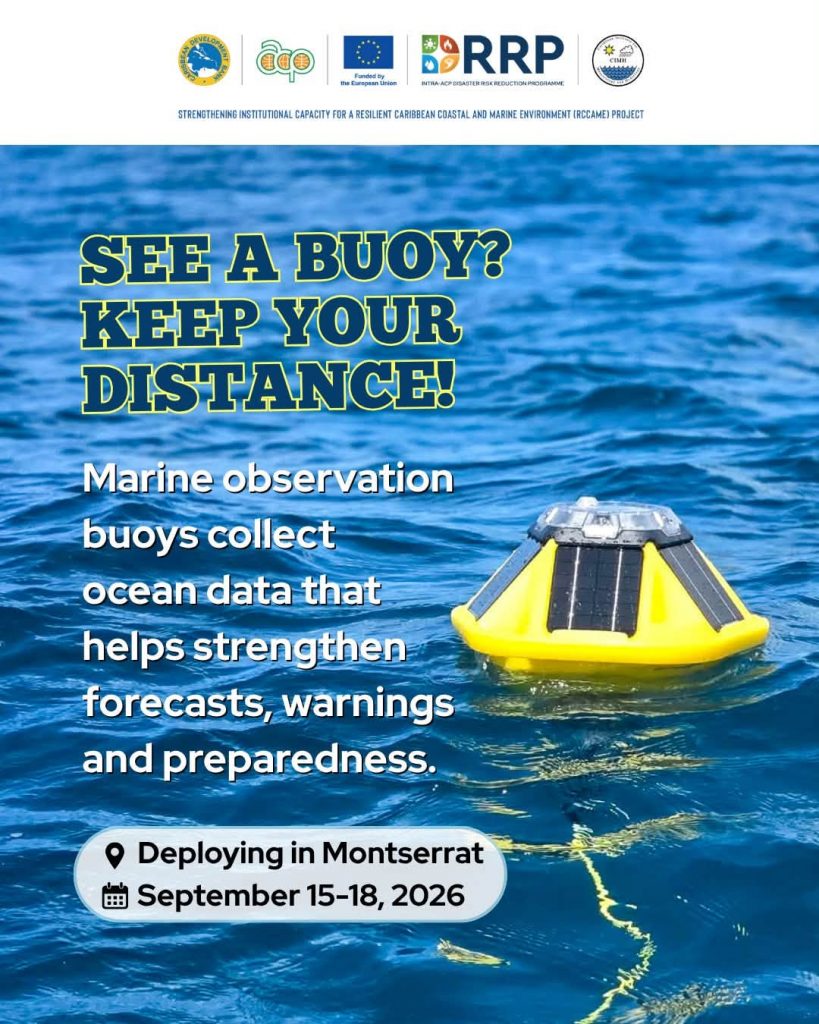
Montserrat will soon be able to collect and transmit near real-time data on ocean conditions through the deployment of a new marine observing system.
The installation of the SOFAR Buoys is the fifth deployment in a regional marine observation network being established by the Caribbean Institute for Meteorology and Hydrology, CIMH, across Caribbean Meteorological Organization member states.
The system, which is being deployed this week, is designed to provide continuous observations of wave and swell conditions, along with other key ocean parameters.
A workshop in preparation for the deployment, took place on Tuesday at the Montserrat Port Authority (MPA). Deployment will take place on Wednesday.
The data collected in Montserrat will help strengthen marine forecasting by supporting the validation and improvement of CIMH’s regional marine forecast models, which provides information on significant wave height, ocean currents, salinity and sea surface temperature, among other marine conditions.
The information is expected to benefit a range of sectors, including marine transportation, fisheries, tourism and coastal management, while also supporting disaster preparedness and response.
Manager at the John A. Osborne Airport, Joseph Irish, says the deployment is an important step towards improving marine forecasting, supporting coastal resilience, and providing critical ocean data for national development and disaster risk management.
He said the vital project will enable more accurate forecasting, not only for marine traffic, but also for fishers and impacts-based forecasters.
Irish said the data will assist forecasters in improving their decision making not only for Montserrat alone but for the region which will enhance the island’s preparedness for Tropical Storms and Hurricanes.
He said this collaborative initiative will help to strengthen the confidence of national forecasters and the general public, knowing that their forecast aligns with regional partners.
The deployment forms part of CIMH’s Strengthening Institutional Capacity for a Resilient Caribbean Coastal and Marine Environment, or RCCAME, project.
The 27-month regional initiative is supported by the Caribbean Development Bank, through the Caribbean Action for Resilience Enhancement Programme, with financing from the European Union.
The first systems in the regional network were deployed in the Turks and Caicos Islands in July.